
Collision with terrain
Black Tusk Helicopter Inc.
Bell 214B-1 (helicopter), C-FBBT
Squamish Municipal Airport (Don Patrick Field) (CYSE), British Columbia, 9 NM SW
The occurrence
On 7 October 2025, a Bell 214B-1 helicopter operated by Black Tusk Helicopter Inc. departed Squamish Municipal Airport, British Columbia, under visual flight rules, to conduct slinging operations from Henriette Lake, British Columbia (BC), to Squamish. The pilot was the sole occupant.
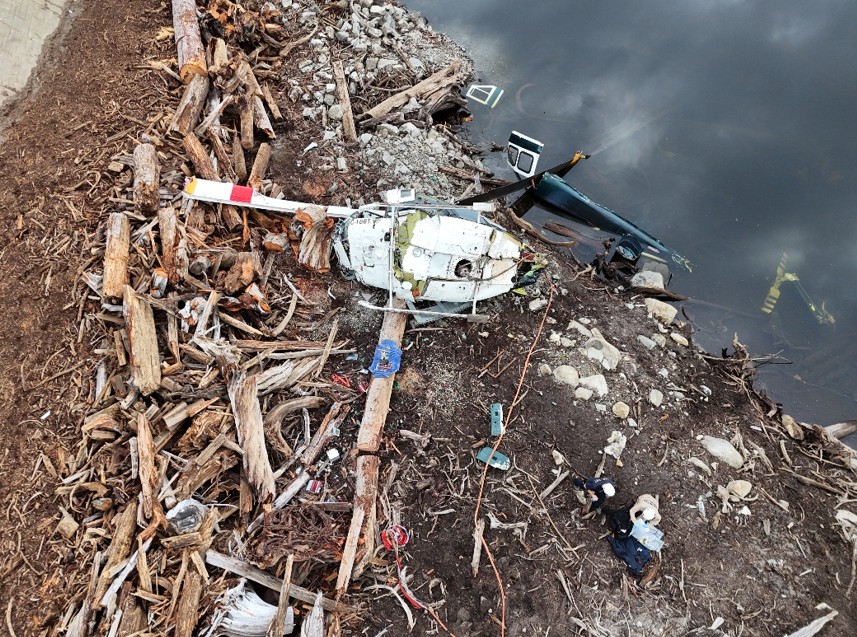
Upon reaching the pickup site, radio contact was established with the lead person on the ground and the crew attached a 4700-pound load to a 125-foot longline. As the pilot began to lift the load, the cargo hook opened, and the load detached. The ground crew reattached the load and a second lift was attempted. When the load reached approximately five feet above the ground, the helicopter descended due to a loss of engine power, and the load struck the ground. The helicopter then moved to the right and collided with terrain on the sloped shoreline, coming to rest on its right side. One of the main rotor blades struck the tail boom, separating the tail gearbox from the body.
No emergency locator transmitter signal was received by the Canadian Mission Control Centre. A nearby company helicopter transmitted a Mayday call that was relayed to the Joint Rescue Coordination Centre in Victoria, BC, and a Canadian Armed Forces Search and Rescue helicopter responded.
The pilot sustained serious injuries. The helicopter was substantially damaged. A team of investigators deployed to the site, and the TSB is investigating.
Work completed at November 2025
The investigation has revealed the following to date:
- During engine removal, loose compressor blades were found in the compressor section.
- The compressor was substantially damaged.
- Survivability: the pilot shoulder harness was not worn, and the pilot’s helmet came off during the accident.
Media materials
Investigation information
Photos
Download high-resolution photos from the TSB Flickr page.
Class of investigation
This is a class 3 investigation. These investigations analyze a small number of safety issues, and may result in recommendations. Class 3 investigations are generally completed within 450 days. For more information, see the Policy on Occurrence Classification.
TSB investigation process
There are 3 phases to a TSB investigation
- Field phase: a team of investigators examines the occurrence site and wreckage, interviews witnesses and collects pertinent information.
- Examination and analysis phase: the TSB reviews pertinent records, tests components of the wreckage in the lab, determines the sequence of events and identifies safety deficiencies. When safety deficiencies are suspected or confirmed, the TSB advises the appropriate authority without waiting until publication of the final report.
- Report phase: a confidential draft report is approved by the Board and sent to persons and corporations who are directly concerned by the report. They then have the opportunity to dispute or correct information they believe to be incorrect. The Board considers all representations before approving the final report, which is subsequently released to the public.
For more information, see our Investigation process page.
The TSB is an independent agency that investigates air, marine, pipeline, and rail transportation occurrences. Its sole aim is the advancement of transportation safety. It is not the function of the Board to assign fault or determine civil or criminal liability.