
Pipeline damage
Westcoast Energy Limited Partnership
16-inch Aitken Creek Lateral, Kilometre Post 3.338
Near Fort St. John, British Columbia
The Transportation Safety Board of Canada (TSB) investigated this occurrence for the purpose of advancing transportation safety. It is not the function of the Board to assign fault or determine civil or criminal liability. This report is not created for use in the context of legal, disciplinary or other proceedings. See Ownership and use of content. Masculine pronouns and position titles may be used to signify all genders to comply with the Canadian Transportation Accident Investigation and Safety Board Act (S.C. 1989, c. 3).
The occurrence
On 15 November 2025, at approximately 1210,All times are Mountain Standard Time. a 16-inch-diameter (nominal pipe size [NPS] 16) pipeline operated by Westcoast Energy Limited Partnership transporting sweet natural gas was struck by a 20-inch-diameter (NPS 20) pipe that was being used as shoring for an observation hole. Approximately 47 310 m3 of sweet natural gas released but did not ignite or explode. The 7 construction crew members who were present within a 25 m radius immediately evacuated. Other pipeline construction crew members working in the area were also evacuated and the site was secured. There were no injuries and evacuation of members of the public was not required.
Construction activities
In October and November 2025, around Blair Creek, located 151 km northwest of Fort St. John, British Columbia (Figure 1), Westcoast Energy Limited Partnership (Westcoast)Westcoast Energy Limited Partnership, an affiliate of Enbridge Inc. and its construction contractor were installing a new 24-inch (nominal pipe size [NPS] 24) pipeline using a pipe thruster and microtunnel boring machineA pipe thruster and a microtunnel boring machine are part of a remotely operated, high-precision, trenchless boring system used to construct pipelines. A cutterhead bores at the front of the microtunnel boring machine with a bentonite slurry circulating to stabilize the tunnel, remove excavated soil, and provide lubrication for the pipe. As the microtunnel boring machine cuts forward, a pipe thruster pushes connected pipe segments forward in a continuous operation, allowing the pipeline to be installed simultaneously as the tunnel is bored. to cross underneath 2 existing Westcoast-operated pipelines, crossing each pipeline twice, for a total of 4 crossings.
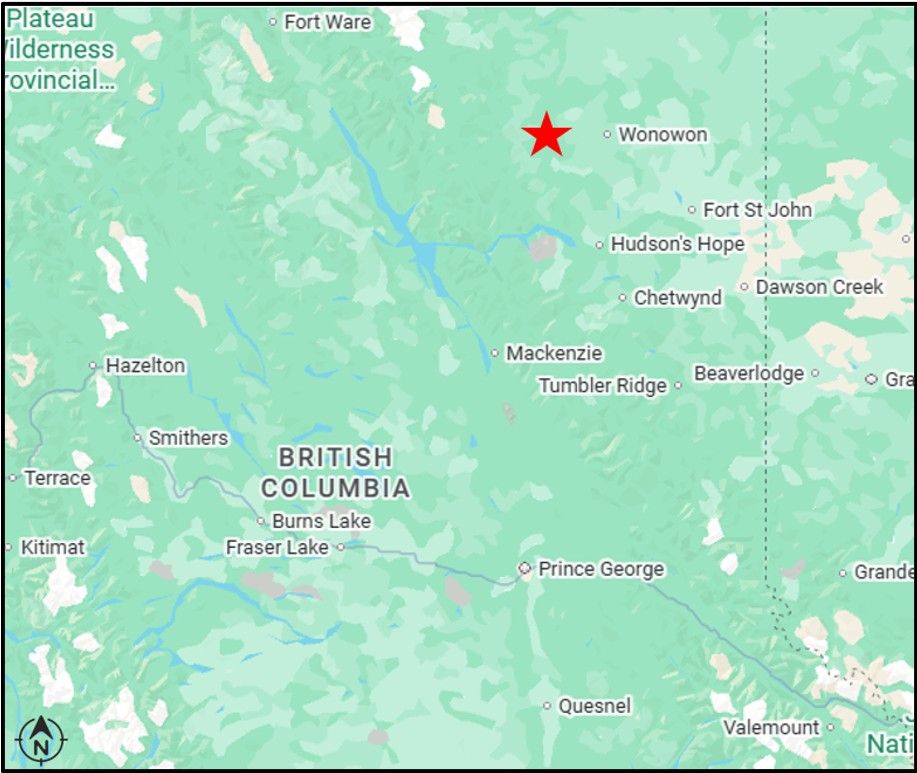
During execution of the 4th and final crossing, which would be under the operating NPS 16 Aitken Creek Lateral pipeline (NPS 16 pipeline), construction crew members began creating an observation holeIn trenchless boring, an observation hole is a hole created in the ground along the bore path near crossing points with other utilities to verify the depth and position of the bore head prior to completing the crossing. Observation holes are typically created using hydro vacuuming. The observation hole’s walls must remain stable while creating and maintaining the hole to ensure the underground bore can be visually identified.,An observation hole is considered a ground disturbance. Broadly, a ground disturbance is any activity that moves or penetrates the ground. Pipeline companies and construction contractors have standard operating procedures for ground disturbance activities to minimize hazards. on the bore path to verify the depth and position of the microtunnel boring machine.
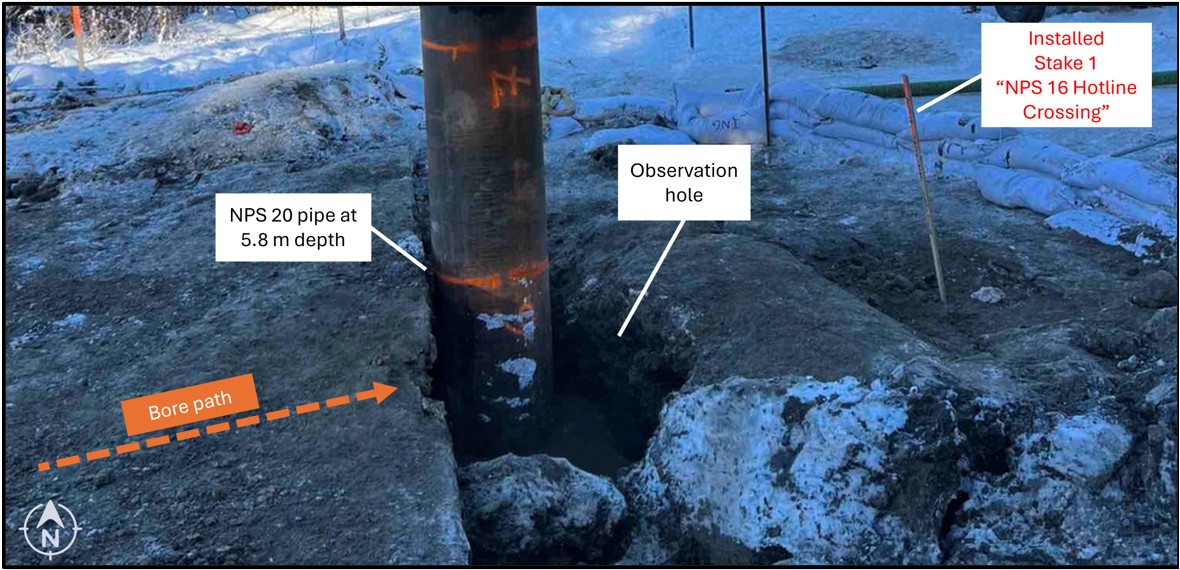
Due to unstable soil conditions that caused the hole’s walls to collapse, and an obstruction encountered within the observation hole, the construction crew began installing an NPS 20 pipe vertically into the hole to act as shoring and break through the obstruction.
After reaching the obstruction at a depth of 5.8 m, an excavator bucket was used to push the NPS 20 pipe through the obstruction. Upon reaching 6 m deep, the crew members within the occurrence area smelled an odour that they interpreted as gas and observed water in the observation hole bubbling upwards approximately 1 to 2 m.
The investigation determined that the NPS 16 pipeline was struck and punctured by the NPS 20 pipe. There was a release of approximately 47 310 m3 of sweet natural gas that did not ignite or explode. At the time of the release, the operating pressure was 5698 kPag (kilopascal gauge).
Background information
On 27 September 2025, in preparation for crossing the NPS 16 pipeline (4th crossing), the NPS 16 pipeline was exposed at the bore crossing location (crossing) by hydro vacuumingHydro vacuuming is an excavation method that uses high-pressure water to break up soil and a powerful vacuum to simultaneously remove the resulting slurry. to visually identify the pipeline and its depth of cover. The construction contractor’s surveyor (surveyor) took survey measurements of the exposed pipeline’s position and depth of cover, which was confirmed to be 5.8 m. A 2-inch-by-4-inch wooden post was then placed by a construction inspector in the hydro vacuumed hole to mark that location, after which the exposed pipe was backfilled.Backfilling was completed to reduce site hazards and the likelihood of bentonite drilling mud migrating through the exposed hole during boring. The post remained in place thereafter to visually indicate the crossing.
On 11 and 12 November 2025, bentonite drilling mud migrated to the crossing area during boring activities, requiring clean-up. During site clean-up activities, the 2-inch-by-4-inch wooden post that marked the location of the crossing was broken and removed from its position. This resulted in losing positive identificationPositive identification is achieved when a buried pipeline is physically exposed to visually confirm its exact location, alignment, direction, depth, and size. After backfilling, positive identification may be maintained using physical markers that accurately represent the confirmed pipeline location. of the crossing. In addition, some survey stakes in the occurrence area were also disturbed.
On 13 and 14 November 2025, to proceed with creating an observation hole prior to completing the crossing, the construction crew members requested that the site be re-staked. They requested that a survey stake be placed to indicate the crossing (Requested Stake 1) and that a second stake be placed on the bore path, at a distance 2 m west of the crossing (Requested Stake 2) for where the observation hole was to be excavated.
On 14 November 2025, the surveyorThis surveyor had surveyed the position and depth of the NPS 16 pipeline on 27 September 2025 (4th crossing). returned to the site to complete the staking. The surveyor noted that the 27 September 2025 coordinate, which reflected the location of the top of the NPS 16 pipeline at the crossing (i.e., Requested Stake 1), was now located in a mud hole that was being cleaned out. Consequently, the surveyor placed a stake (Installed Stake 1) at an offset, approximately 1.4 m east from the crossing, and labelled it “NPS 16 Hotline Crossing” (Figure 2). In selecting the location where the surveyor placed the stake, the surveyor relied on previously logged pipeline location data.
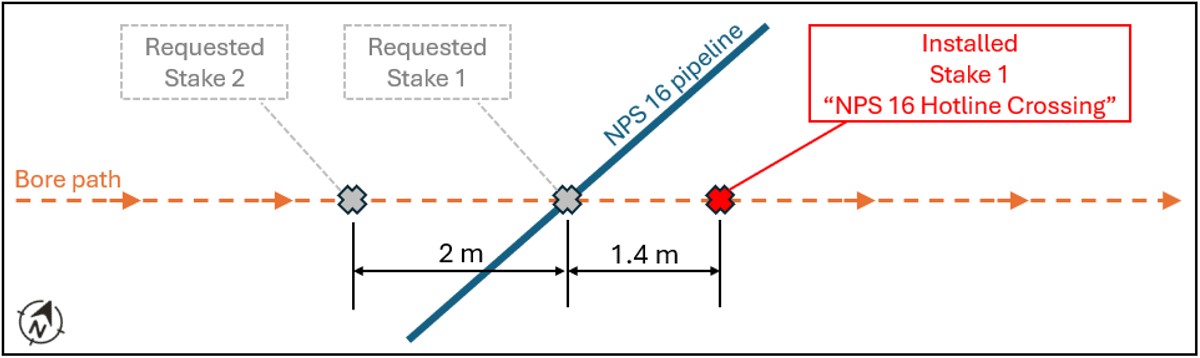
The construction crew was not made aware that Installed Stake 1 was offset east from the crossing. Therefore, as originally planned, they proceeded to create the observation hole approximately 2 m west of that stake to confirm the location of the microtunnel boring machine before it crossed underneath the NPS 16 pipeline.
Prior to shoring the observation hole with the NPS 20 pipe, the construction crew unsuccessfully attempted to use a 20-inch metal corrugated culvert as shoring but encountered an obstruction at a depth of 5.8 m. Considering the obstruction to be wooden material,When hydro vacuuming other observation holes at this job site, crew members had encountered wooden material, including trunks and logs. During hydro vacuuming of the occurrence observation hole, multiple crew members had observed non-soil material and believed that it was wooden material. it was decided to use an NPS 20 pipe with bevelled ends to push through the obstruction and act as shoring (Figure 3).
Initial response
Following the occurrence, emergency response protocols were enacted. Construction crews around Blair Creek evacuated and the pipeline was subsequently isolated and blown down to 0 kPag.
A 6.2 m-long damaged section of the NPS 16 pipeline was cut out and sent for laboratory analysis. The NPS 16 pipeline was repaired and returned to service on 05 December 2025.
Laboratory analysis
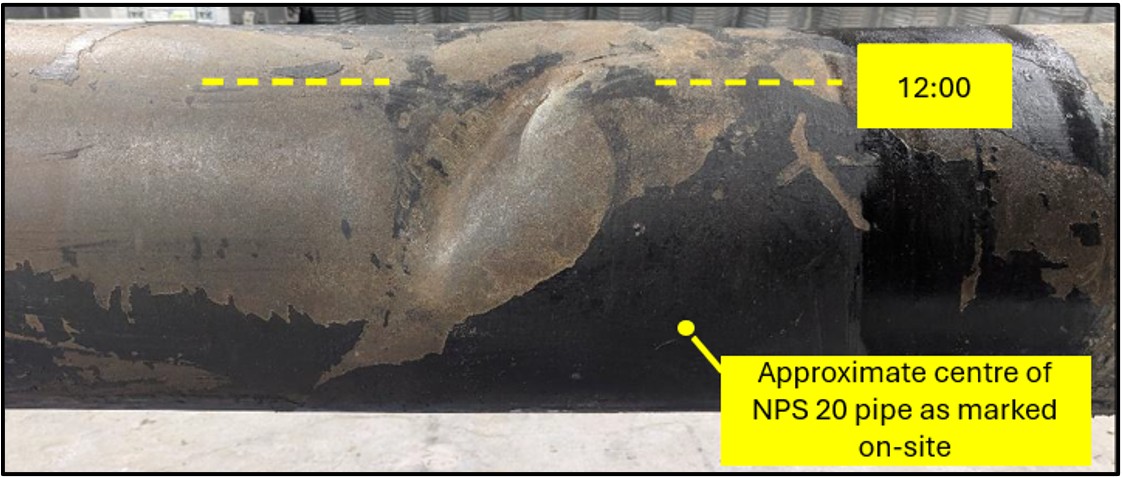
The NPS 16 line pipe had an outer black plastic rock guard wrap and a yellow extruded polyethylene coating, and its measured wall thickness ranged from 6.14 to 6.22 mm. The outer black rock guard wrap was damaged at the 12:00 position (top dead centre of the pipe). No wooden material was observed.
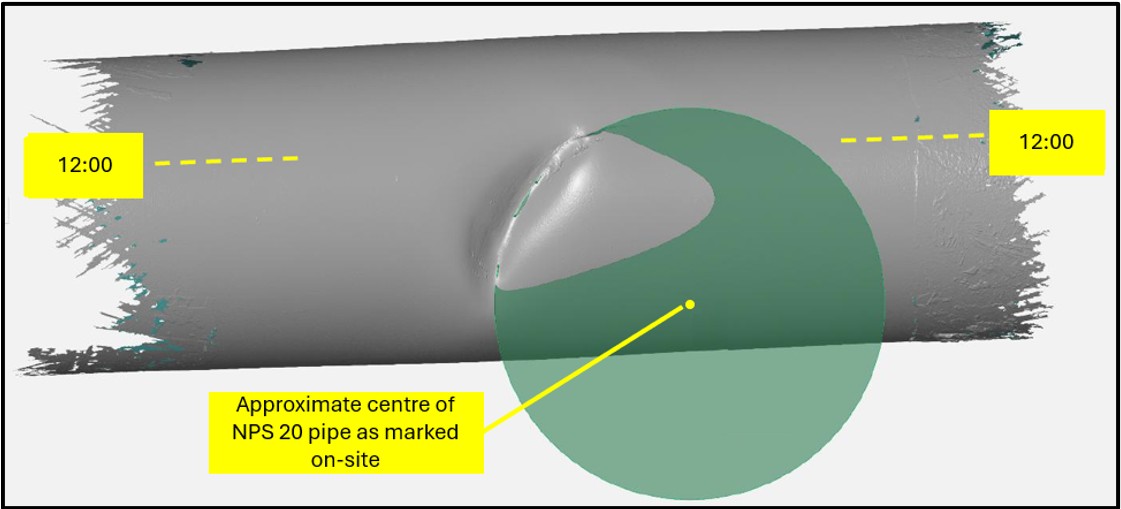
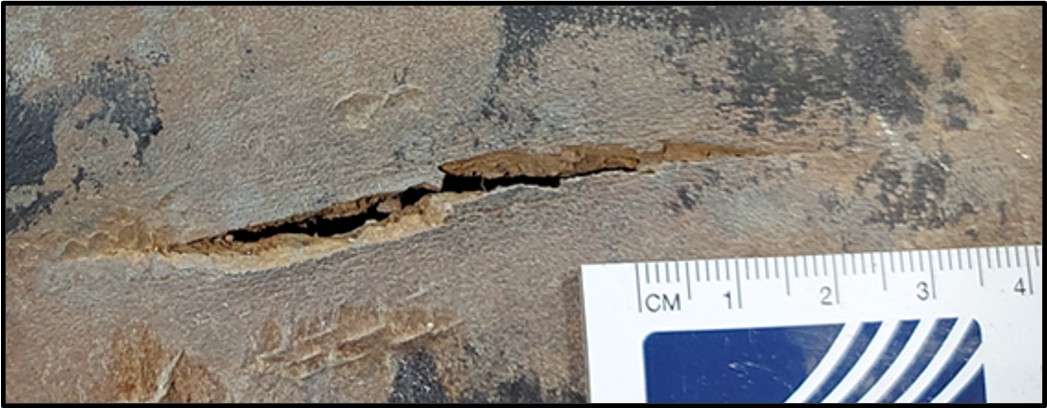
The damaged area of the NPS 16 line pipe was laser scanned and its damage appeared to be consistent with an impact by a solid object with an outside diameter of 20 inches (508 mm) (Figure 4 and Figure 5). A breach was noted in this area by a crack/tear that was approximately 61 mm long with a maximum width of 5 mm (Figure 6). There was significant deformation and presence of gouging and scrapes within this breached area. There was no evidence of corrosion or stress corrosion cracking at this location.
Conclusion
In preparation for completing the trenchless crossing underneath the NPS 16 pipeline, the location of the pipeline at the crossing was verified by exposing the pipeline and marking its location with a 2-inch-by-4-inch wooden post. When changing site conditions resulted in the removal of the 2-inch-by-4-inch wooden post, the location of the pipeline was no longer positively identified. Construction crews no longer knew the exact location of the pipeline and therefore requested re-staking. A new stake was installed without re-exposing the NPS 16 pipeline, resulting in inaccurate identification of the pipeline’s location. When the construction crew began the observation hole, they relied on the incorrectly positioned stake as an indication of the location of the NPS 16 pipeline.
Safety action taken
Following the occurrence:
- On 05 December 2025, the Canada Energy Regulator (CER) issued Inspection Officer Order SN-001-2025 to Westcoast and Inspection Officer Order VS-002-2025 to the construction contractor specifying actions to undertake related to ground disturbance and pipeline identification processes. After reviewing the completed actions from both parties, the CER issued a Notice of Measures Satisfied to both parties in February 2026.
- Westcoast updated its ground disturbance procedures and provided refresher training to construction inspectors.
- The construction contractor updated its ground disturbance job hazard procedures and competency evaluations and provided refresher training to the NPS 24 pipeline project personnel.
Safety message
This occurrence highlights the importance for construction crews to positively identify buried facilities before conducting ground disturbance activities in close proximity. Not doing so can lead to injuries and damage to the environment and infrastructure.
This report concludes the Transportation Safety Board of Canada’s investigation into this occurrence. The Board authorized the release of this report on 27 May 2026. It was officially released on 29 June 2026.