
Main-track derailment
Canadian National Railway Company
Mile 30.66, Dundas Subdivision
Paris, Ontario
The Transportation Safety Board of Canada (TSB) investigated this occurrence for the purpose of advancing transportation safety. It is not the function of the Board to assign fault or determine civil or criminal liability. This report is not created for use in the context of legal, disciplinary or other proceedings. See Ownership and use of content. Masculine pronouns and position titles may be used to signify all genders to comply with the Canadian Transportation Accident Investigation and Safety Board Act (S.C. 1989, c. 3).
The occurrence
On 25 July 2025 at about 0135,All times are Eastern Daylight Time. Canadian National Railway Company (CN) mixed-merchandise freight train M38331-24 departed MacMillan Yard in Toronto, Ontario,All locations are in the province of Ontario, unless otherwise indicated. en route to Lang Yard, Ohio, United States.
The train, which comprised 172 rail cars (149 loaded cars, 18 empty cars, and 5 residue cars), was configured with 4 locomotives at the head end (the 4th was isolated and not contributing to tractive power or dynamic braking), 1 distributed power (DP) remote-controlled locomotive about mid-train in position 98, and an end-of-train (EOT) device at the tail end. It weighed 20 346 tons and measured 11 909 feet.
Due to unanticipated pre-departure delays, an en-route crew change was required to ensure that the crew did not exceed allowable on-duty time limits. The locomotive engineer (LE) discussed the situation with the rail traffic controller, and it was decided that the crew change would take place near the Market Street crossing in the town of Paris.
At about 0505, while proceeding westward on the north main track of the Dundas Subdivision, the train was approaching the crew change location. The LE made a series of brake applications, bringing the train to a stop with its head end at Mile 30.55, about 950 feet short of where the relief crew was waiting at Mile 30.73. The LE then resumed movement of the train with the intention of stopping closer to the relief crew’s location; however, the train had difficulty moving forward. The LE increased the throttle to position 3 and subsequently to position 4. At 0510, the train was travelling at about 0.8 mph and had moved a distance of 454 feet (the head end was at Mile 30.66) when a train-initiated emergency brake application occurred.
Subsequent inspection determined that the mid-train locomotive derailed, along with 23 cars in 2 distinct blocks: positions 85 to 99 and 149 to 157. All derailed rolling stock remained upright. Two of the derailed cars were tank cars containing hydrochloric acid (UN1789), however, neither were breached. The derailment resulted in significant rail and track damage. No injuries were reported.
Train handling
To assess train handling, locomotive event recorder (LER) data from the lead and mid-train remote locomotives were reviewed. The data indicate the following:
- During initial braking while approaching the Market Street crossing at 30.1 mph, the LE made a 7 psi brake pipe pressure (BPP) reduction.
- About 20 seconds later, while the train was travelling at 28.5 mph, the LE made a supplemental 10 psi BPP reduction, followed 9 seconds later by an additional 4 psi BPP reduction, for a total reduction of 21 psi.
- Between the second and third BPP reduction, while the train was travelling at 27.8 mph, the LE applied low-level dynamic braking (DB2) and modulated between DB3 and DB4 during the next 20 seconds.
- When train speed had decreased to approximately 7.7 mph, the LE started to apply the locomotive independent brakes.
Track condition
The TSB reviewed the urgent and near-urgent track defectsUrgent defects require a mandatory slow order (unless corrected before passing of a train) and include all Transport Canada condemnable defects thresholds. Near-urgent defects are within ⅛ inch of becoming urgent defects. reported for the Dundas Subdivision in the year preceding the occurrence. The tangent track where the train derailed was in good condition; it had no geometry, subgrade, rail creep, or joint issues.
Brake pipe continuity
To assess brake pipe continuity, LER data from the lead locomotive—which also records the EOT device data transmitted to the locomotive—were reviewed, along with LER data from the mid-train remote locomotive. The data indicate the following:
- The initial BPP reduction of 7 psi took about 15 seconds to register at the EOT device, which is considered a normal rate of brake signal propagation.
- The subsequent BPP reduction of 10 psi took about 45 seconds to register at the EOT device. This delayed response is consistent with a localized air flow restriction in the brake pipe.
- The additional BPP reduction of 4 psi did not initially propagate to the tail end of the train. However, about 37 seconds later, the EOT device began to register a reduction in BPP, decreasing from 82 to 72 psi in 2 seconds. This response indicates that the air flow restriction was intermittent and had subsequently cleared, allowing the BPP reduction to propagate to the tail end of the train.
- The mid-train remote locomotive was being operated in DP synchronous mode with the lead locomotive and responded appropriately—typically within 1 or 2 seconds—to all throttle, dynamic braking, and air braking commands. There were no intermittent interruptions in DP radio communications, and the brake signal propagation was normal up to the mid-remote locomotive.To determine whether other indications of intermittent brake signal propagation were present, LER data from earlier in the trip were reviewed, beginning at the train’s departure from McMillan Yard. No other anomalies were identified.
The air flow restriction was located between the remote locomotive and the EOT device, but the exact location could not be determined from the LER data. This restriction and resulting delay in brake signal propagation placed the train in a state of unbalanced braking, with the head-end and mid-train portions responding to a total BPP reduction of 21 psi, while the tail end was responding to a BPP reduction of 7 psi. Under these conditions, the rear portion of the train would have run in toward the front portion, generating elevated buff forces.
Excessive buff forces can cause wheel unloading and, in some circumstances, wheel lift on lightly loaded or empty cars, which can result in a derailment. At the front of the first block of derailed cars, the cars in positions 85 to 88 were empty.
Kinked intermediate air hoses
On the occurrence train, there were 81 rail cars equipped with end-of-car cushioning devices (EOCCDs). Cars equipped with EOCCDs use long underslung intermediate air hoses to accommodate the EOCCD’s increased longitudinal travel (Figure 1). Due to the hoses’ length and routing, they are more prone to kinking under in-train slack action than the shorter hoses used on cars equipped with standard draft gear.
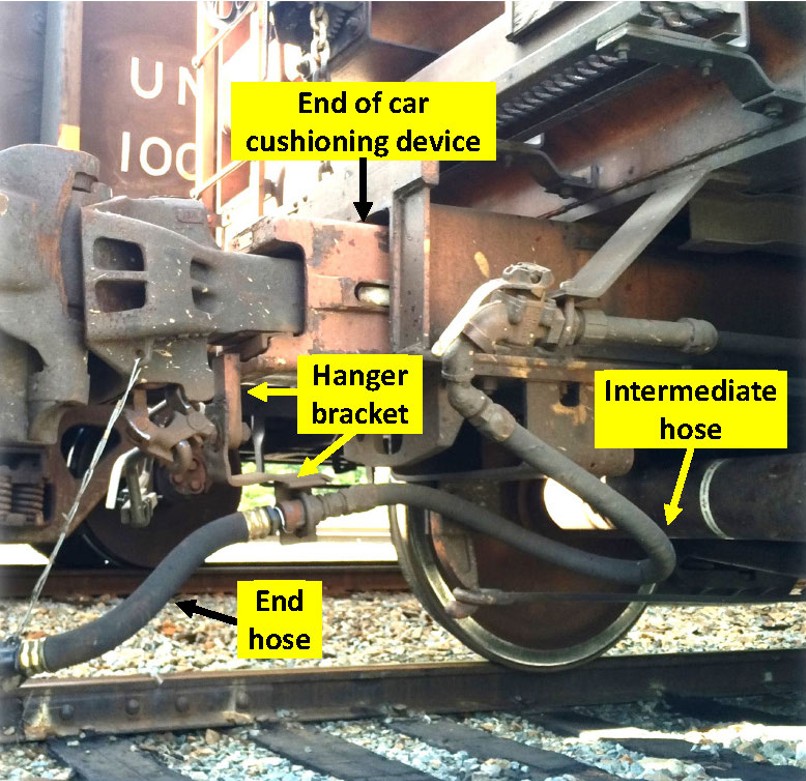
If the movement of the intermediate hose becomes impeded when the EOCCD is compressed under buff forces, the hose can bend further where it is looped beneath the rail car. If this bending becomes excessive, the hose may fold over on itself, creating a kink that can partially restrict or completely block the normal flow of air through the brake pipe. Such restrictions can result in intermittent air flow in the brake pipe and impede brake signal propagation.
On some older cars manufactured to meet earlier Association of American Railroads (AAR) specifications for end arrangements, the intermediate hoses on EOCCD-equipped rail cars are particularly susceptible to kinking. Current AAR standards for end arrangements, updated in 1999, do not permit the use of end arrangements that pre-date the current standards in new or modified installations, as these arrangements were prone to damage, malfunction, and poor performance, which could impede the proper movement of the intermediate hose. There is no AAR requirement to upgrade end arrangements to comply with newer standards unless the end arrangements are found to be damaged and require repair.
Based on available records, 13 of the 81 rail cars equipped with EOCCDs on the occurrence train were confirmed to have been built before the current standards were introduced.Because build dates are not available for all rail cars in the Universal Machine Language Equipment Register (UMLER) database, additional rail cars equipped with end-of-car cushioning devices with legacy end arrangements may have been present in the train consist. On the occurrence train, the build date was unavailable for 123 of the 172 cars; of the 81 cars equipped with end-of-car cushioning devices, the build date was unavailable for 35. UMLER is the rail industry’s central repository for registered rail and intermodal equipment in North America. These cars were originally equipped with legacy end arrangements,The investigation did not confirm whether, subsequent to manufacture, these cars were modified with a newer style end arrangement based on an updated standard. including long intermediate air hoses, which are prone to kinking under buff forces. Ten of these rail cars were located behind the remote locomotive.
Train dynamics simulations
Train dynamics simulations were conducted to replicate the actual train configuration, track alignment,For westbound movements, the track alignment approaching the crossing is predominantly tangent, with 2 to 3 shallow curves, and includes a slight undulating grade consisting of an approximate 0.4% descending grade followed by a 0.7% ascending grade. and train-handling sequence used by the LE.Simulation results are order-of-magnitude estimates based on modelling assumptions and input data; however, they provide useful comparative insight into relative force levels and train dynamic behaviour.
Baseline simulations (normal brake signal propagation with actual train handling) were conducted and indicated the following:
- Braking and throttle inputs applied by the LE did not generate in-train forces of sufficient magnitude to derail any of the cars.
- The train was capable of resuming movement from a stop using relatively low throttle. However, unlike the simulation, the LER data showed difficulty in moving the train despite higher throttle settings, which is consistent with one or more cars having derailed before the attempted movement.
Additional simulations were conducted to evaluate longitudinal in-train forces associated with assumed air flow restriction locations and to determine whether such locations could generate buff forces sufficient to cause wheel unloading and wheel-lift derailment. The exact location and extent of the air flow restriction could not be determined from the available physical evidence and recorded data; however, the simulations resulted in the following observations:
- In the presence of a localized air flow restriction in the brake pipe, located somewhere behind the mid-train remote locomotive, buff forces were most concentrated on the empty cars in positions 85 to 88, located at the front of the 1st block of derailed equipment, which comprised 15 cars (positions 85 to 99). These cars were the most susceptible to wheel unloading.
- Buff forces sufficiently elevated to produce a wheel-lift derailment on the first derailed empty cars could only be generated when an air flow restriction was located in the section of cars from positions 99 to 118. The highest buff forces occurred when the restriction was nearest the mid-train locomotive, and the force magnitude decreased as the restriction location moved farther toward the rear of the train.For a restriction between positions 99 and 100, approximately 8406 tons of trailing tonnage acted against about 11 940 tons ahead. For a restriction between positions 117 and 118, approximately 6334 tons of trailing tonnage acted against about 14 012 tons ahead, resulting in lower compressive forces.
Despite the review of LER data and the train dynamics simulations, the investigation could not determine which specific empty car derailed first or whether multiple cars derailed in rapid succession.
Safety message
The railway industry is reminded that the long intermediate hoses used on rail cars equipped with EOCCDs present an increased risk of kinking under elevated buff forces, particularly on cars with legacy end arrangements, which can result in intermittent air flow restrictions in the brake pipe.
This report concludes the Transportation Safety Board of Canada’s investigation into this occurrence. The Board authorized the release of this report on 27 May 2026. It was officially released on 22 June 2026.