
10 July 2026
Director General, Rail Safety and Security
Transport Canada
Enterprise Building, 14th floor
427 Laurier Avenue West
Ottawa ON K1A 0N5
On 05 July 2026, Canadian National Railway Company (CN) freight train A46121-05 was travelling southward at 48 mph on the main track of CN’s Joliette Subdivision. The train consisted of 2 locomotives at the head end (locomotives CN 3079 and NS 3651), 1 a mid-train remote-controlled distributed power locomotive (NS 4153), and 172 rail cars.142 loaded cars, 17 empty cars, and 13 tank cars containing dangerous goods residue. It weighed 19 862 tons and was 11 449 feet long.
At about 1630, after the head-end locomotives had crossed the public grade crossing on Boulevard Le Bourg-Neuf in Repentigny, Quebec,All locations are in the province of Quebec. located at Mile 120.68 (Figure 1), a train-initiated emergency brake application occurred. Once the train came to a stop, the crew observed that several cars had derailed.Based on preliminary information obtained by the TSB, the number of derailed cars is estimated at 49. The derailed cars were scattered in various positions near residences on both sides of the right-of-way. No one was injured, and there was no release of dangerous goods.
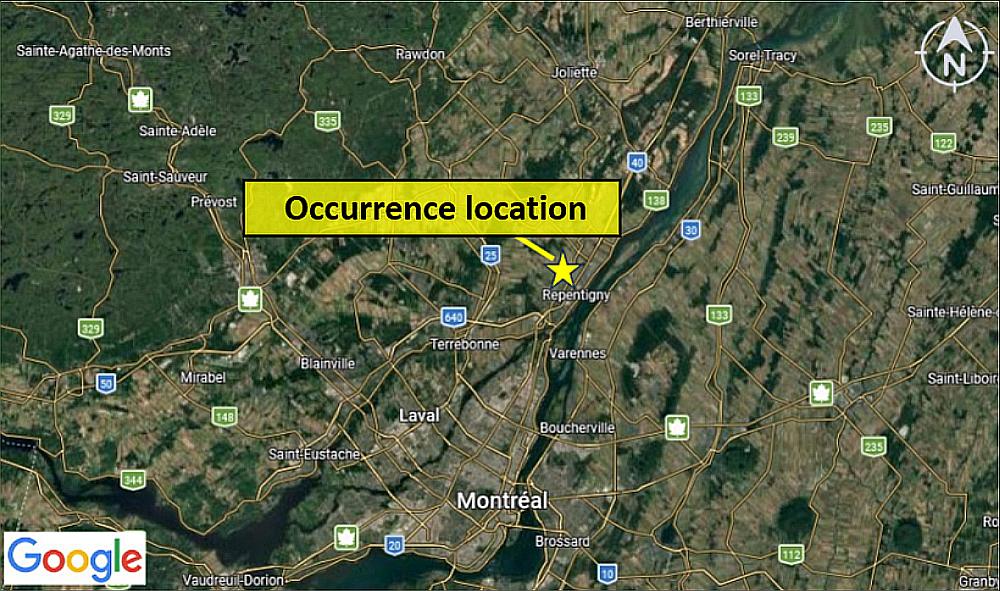
At the time of the occurrence, the sky was clear, and the temperature was 29 °C.
The Joliette Subdivision is CN’s main rail corridor on the north shore of the St. Lawrence River. All rail traffic in northern Quebec originating from the Abitibi-Témiscamingue, Mauricie, and Saguenay–Lac-St-Jean regions runs through this subdivision. Rail traffic on this subdivision consists on average of 6 freight trains and 1 passenger train per day, for a total annual tonnage of about 10.1 million tons. The subdivision is not considered a “key route”’Key Route’ means any track on which, over a period of one year, is carried 10,000 or more loaded tank cars or loaded intermodal portable tanks containing dangerous goods, as defined in the Transportation of Dangerous Goods Act, 1992 or any combination thereof that includes 10,000 or more loaded tank cars and loaded intermodal portable tanks.” (Source: Rules Respecting Key Trains and Key Routes [22 August 2021, approved by Transport Canada on 22 February 2021], Section 3.1.) as defined in the Rules Respecting Key Trains and Routes approved by Transport Canada.
The Joliette subdivision is a single-track main line running north to south from the Garneau Yard (Mile 40.1) in St-Georges-de-Champlain to Pointe-aux-Trembles (Mile 127.8). Train traffic on the subdivision is governed by Occupancy Control System up to Mile 123.8 and by the Centralized Traffic Control system thereafter, in accordance with the Canadian Rail Operating Rules. All train movements are supervised by a CN rail traffic controller based in Edmonton, Alberta.
The track on the Joliette Subdivision is classified as Class 4 under the Rules Respecting Track Safety, also known as the Track Safety Rules (TSR) approved by Transport Canada. In the vicinity of the occurrence, the maximum authorized speed is 50 mph for freight trains and 75 mph for passenger trains.
Heat-related speed restrictions are in effect on this subdivision for all trains. Throughout the entire subdivision, freight trains must reduce their maximum speed to 30 mph if the ambient temperature exceeds 35 °C. From Mile 78 to Mile 127.8, freight trains must reduce their speed by 10 mph when the ambient temperature is between 30 °C and 34 °C.
In the area where the train derailed, the track consisted of 115-pound continuous welded rail (CWR) manufactured in 1965. The rails were laid on No. 1 hardwood ties, fitted with 11-inch double-shoulder tie plates secured with 2 to 3 spikes per plate. The rails were held in place by rail anchors.Rail anchors are devices attached to the rail base that bear against the ties to prevent longitudinal rail movement (rail creep) and maintain track geometry and stability. They resist the longitudinal forces generated by train movements, braking, acceleration, and temperature variations. The ballast consisted of crushed rock.
Observations of track conditions by TSB investigators
Following the accident, a team of TSB investigators attended the site to assess the occurrenceThis occurrence is classified by the TSB as a Class 3 investigation. and to collect and examine data related to train operation the condition of the rolling stock and the condition of the track and infrastructure.
Investigators examined the track in the area of the derailment, as well as 8 other sectionsEach track section measured approximately 600 to 700 feet in length. of track that had not been affected by the derailment from approximately Mile 116 to Mile 122).
The number of ties in good condition met the TSR requirements for a Class 4 track. The number of spikes securing the tie plates to the ties was sufficient for this category of track. The crushed rock ballast appeared to be in good condition. The track platform and the drainage in the vicinity of the occurrence location did not show any apparent deficiencies. However, there was presence of water in the ditch on the west side of the track.
The TSR also requires that the track have a sufficient number of rail anchors to prevent longitudinal movement. For CWR track on the Joliette Subdivision, CN’s Engineering Track Standards stipulate that, for every 2 ties, 4 rail anchors must be installed per tie.
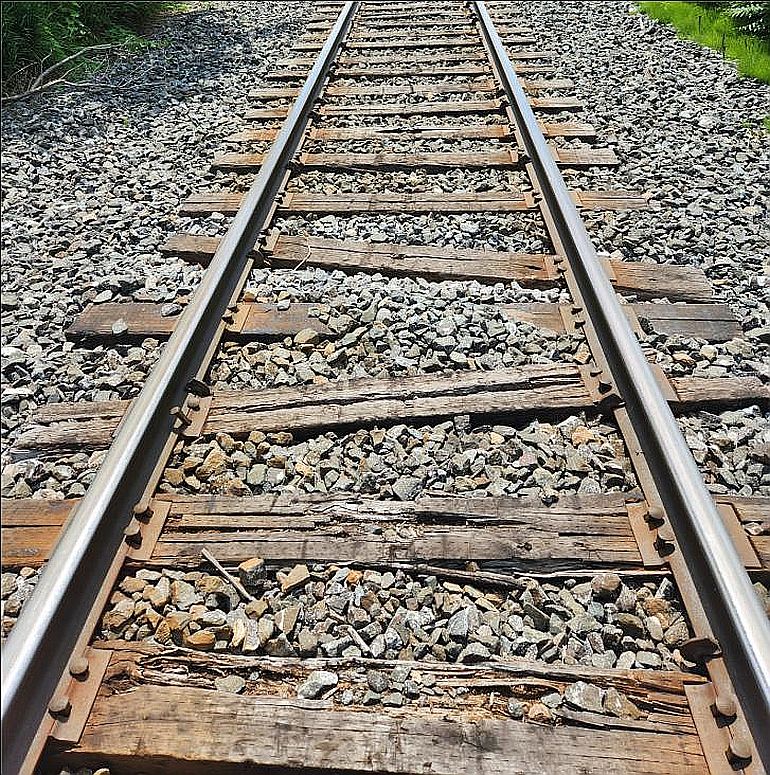
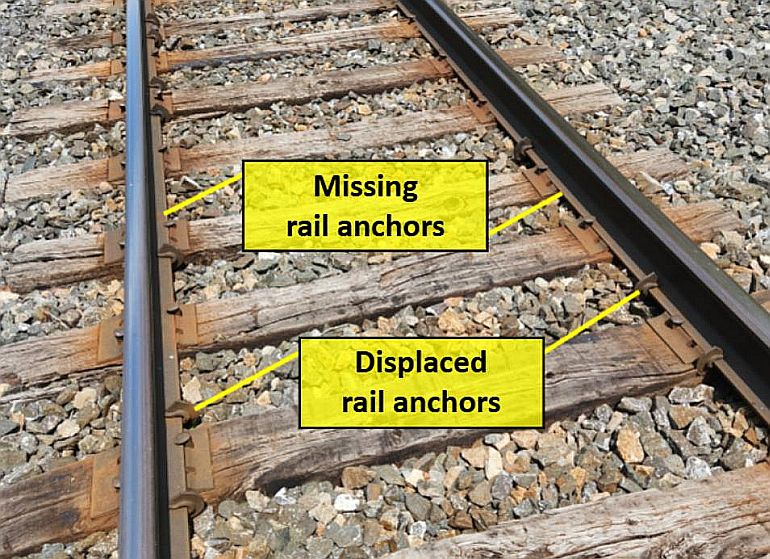
According to the investigators’ initial observations, several deficiencies were identified in relation to the track. Specifically, between Mile 118 and Mile 121, rail anchors were missing or had displaced in a few locations. Furthermore, several ties were skewed and were no longer perpendicular to the rails (Figures 2 and 3).
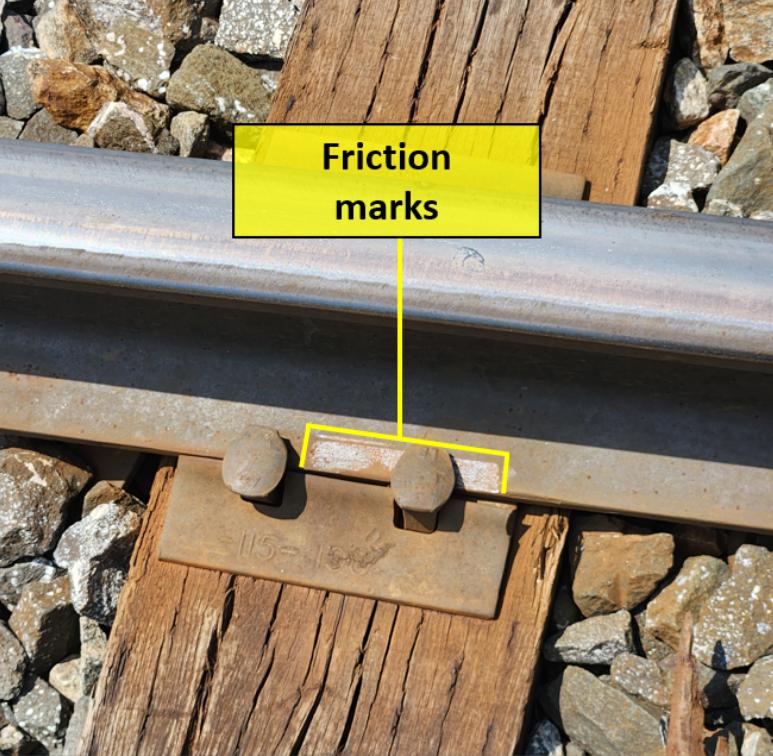
In several locations, the rail showed signs of friction from the spikes against the tie, indicating longitudinal displacement that, in some cases, could be as much as 3.5 inches (Figure 4).
Missing or displaced rail anchors could lead to a local redistribution of stresses in the rail and reduce the longitudinal and lateral stability of the track, which could increase the risk of derailment due to track buckling.
Given these risks, Transport Canada may wish to consider verifying the integrity of the track on the CN Joliette Subdivision to ensure that it is safe and meets operational requirements.
The TSB would appreciate being informed of what action, if any, will be taken in this regard.
Yours sincerely,
Original signed by
Vincenzo De Angelis
Director, Investigations – Rail/Pipeline