
Mid-air collision
Cornwall Aviation (1979) Ltd.
Cessna 172N, C-GGXP
and
Piper PA-44-180, C-GBJJ
Cornwall Regional Airport (CYCC), Ontario, 9NM NNW
The occurrence
On 15 November 2025, at approximately 10:57 Eastern Standard Time, two aircraft operated by Cornwall Aviation (1979) Ltd., a Cessna 172N and a Piper PA-44-180, collided mid-air near the Cornwall Regional Airport, Ontario.
Following the collision, the Cessna 172N, with the pilot as the sole occupant, descended uncontrolled, and impacted terrain in a forested swampy area. The aircraft was destroyed. There was no post-impact fire, and the aircraft’s emergency locator transmitter did not transmit a detectable signal. The pilot of the Cessna 172N was fatally injured.
The Piper PA-44-180, with two occupants on board, was significantly damaged but remained controllable and landed safely at the Cornwall Regional Airport. The TSB is investigating.
Work completed at February 2026
- Initial examinations of both aircraft have been completed, and the involved pilots, eyewitnesses, first responders, aircraft owners, and regulatory personnel have been interviewed.
- The relevant operational, maintenance, and training documentation have been obtained.
- Radar data was received by the TSB Laboratory and used to -reconstruct the flight path. The radar data and the reconstructed flight path data have been reviewed.
- The radar data and the reconstructed flight path data indicate that the two aircraft crossed flight paths multiple times before the collision. At the time, instrument flight training and visual flight training were being conducted in the same area.
- One aircraft was conducting a flight test with an examiner on board. The investigation is examining how training and testing activities were planned, coordinated, and deconflicted.
- Both aircraft were operated by the same flight training unit. Training practices, airspace usage, scheduling, traffic awareness, and see-and-avoid considerations are being examined.
- The ELT from the Cessna 172N did not produce a detectable signal; the ELT installation, activation, and signal transmission are being examined.
- No safety communications have been issued at this stage.
Investigation information
Photos
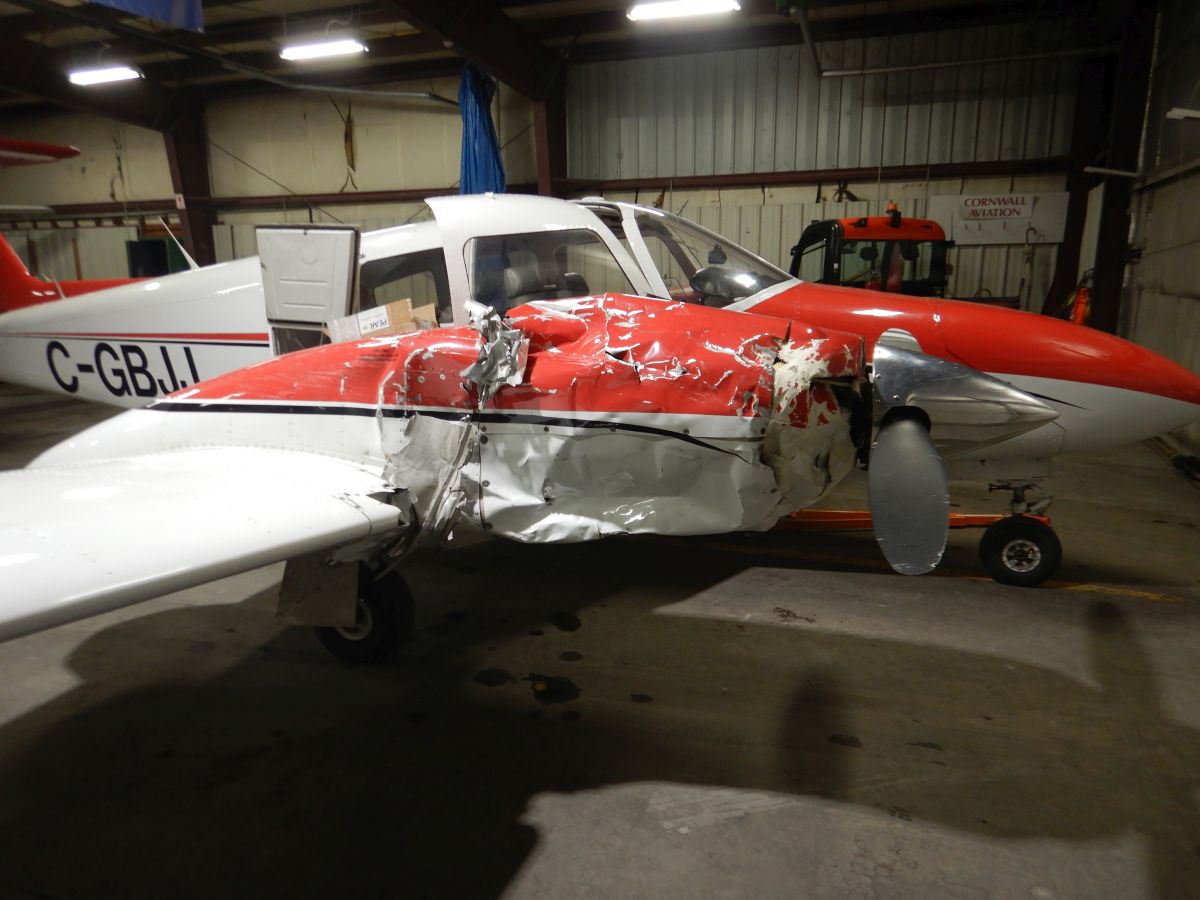
Download high-resolution photos from the TSB Flickr page.
Class of investigation
This is a class 3 investigation. These investigations analyze a small number of safety issues, and may result in recommendations. Class 3 investigations are generally completed within 450 days. For more information, see the Policy on Occurrence Classification.
TSB investigation process
There are 3 phases to a TSB investigation
- Field phase: a team of investigators examines the occurrence site and wreckage, interviews witnesses and collects pertinent information.
- Examination and analysis phase: the TSB reviews pertinent records, tests components of the wreckage in the lab, determines the sequence of events and identifies safety deficiencies. When safety deficiencies are suspected or confirmed, the TSB advises the appropriate authority without waiting until publication of the final report.
- Report phase: a confidential draft report is approved by the Board and sent to persons and corporations who are directly concerned by the report. They then have the opportunity to dispute or correct information they believe to be incorrect. The Board considers all representations before approving the final report, which is subsequently released to the public.
For more information, see our Investigation process page.
The TSB is an independent agency that investigates air, marine, pipeline, and rail transportation occurrences. Its sole aim is the advancement of transportation safety. It is not the function of the Board to assign fault or determine civil or criminal liability.